















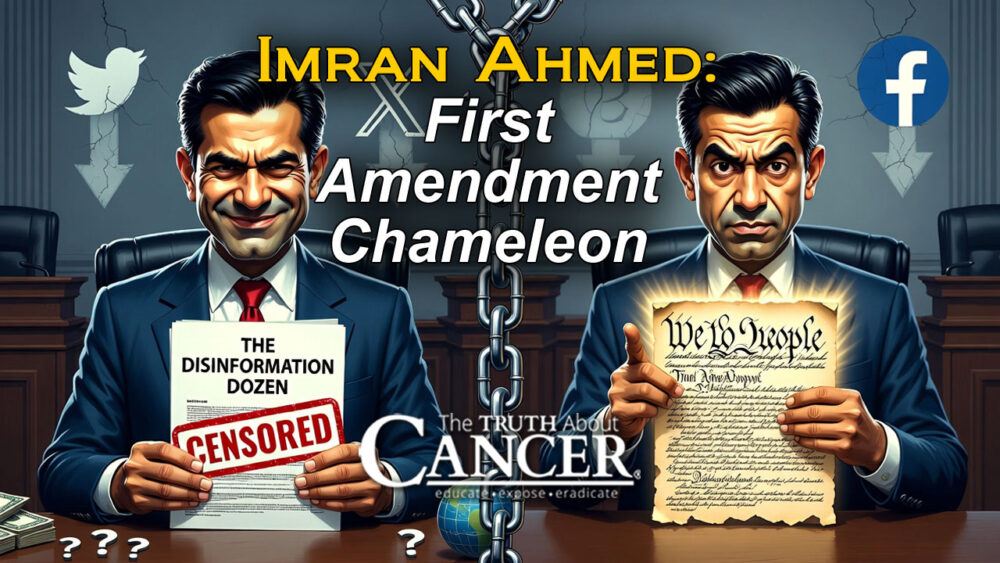
If you ever needed proof that hypocrisy is not a bug but a feature in the digital age, look no further than Imran Ahmed, the CEO of the Center for Countering Digital Hate (CCDH). For years, Ahmed’s organization acted as a self-appointed speech police, famously publishing the “Disinformation Dozen” report that pressured social media platforms to deplatform specific individuals, including us. Now, facing a potential visa revocation from the U.S., Ahmed has reportedly clutched the very First Amendment he helped others sidestep, pleading for “constitutional protection.” The irony is so thick you could cut it with a censor’s scissors.
The Architect of the “Disinformation Dozen”
Ahmed’s CCDH rose to notoriety in 2021 with its “Disinformation Dozen” report. The document, which named individuals like ourselves (Ty & Charlene Bollinger) and Robert F. Kennedy Jr., claimed that just twelve people were responsible for the bulk of online “anti-vaccine misinformation.” The report was cited by the White House and mainstream media to justify pressure on social media companies to remove content. According to critics, the report’s statistics were flawed by a “300-fold magnitude of error,” yet it became a cornerstone for a wider censorship campaign.
The group’s mission to police digital speech has been aggressive. Leaked documents reveal plans for “black ops” against public figures and a directive to “kill Musk’s Twitter” to stifle dissenting voices on the platform. For a man whose professional life has been dedicated to defining and suppressing what he deems “hate” or “disinformation,” Ahmed’s sudden personal appeal to free speech principles is a breathtaking pivot.
The Web of Funding and Foreign Ties
What makes Ahmed’s First Amendment plea even more audacious is the shadowy network behind his organization. Leaked information and investigations paint a picture of a group far from a simple watchdog:
-
Soros-Linked Money: In 2025, it was revealed that CCDH accepted a $250,000 grant from the Open Society Foundations, an organization founded and funded by George Soros. This grant was for “general support” and offered a rare glimpse into CCDH’s otherwise opaque finances.
-
A Network of “Dark Money”: Investigative reports describe a “web of 20+ funders” supporting CCDH, including donor-advised funds that allow for complete donor anonymity. Other funders have ties to major Democratic Party-aligned networks and to global health initiatives linked to figures such as Bill Gates.
-
Foreign Government Collaboration: Perhaps most damning are the leaked 2025 emails that reveal a “collaborative relationship” between CCDH and the Israeli government. The emails suggest coordinated efforts to monitor content and counter voices critical of Israeli policies, with critics alleging a “pay-to-play dynamic.”
This context frames Ahmed not as a simple activist, but as the head of an organization accused of being a “sophisticated influence weapon” backed by foreign, anonymous capital to shape U.S. discourse.
The Reckoning: Congressional Scrutiny and Potential Deportation
Ahmed’s strategy has attracted powerful opposition. In 2023, Rep. Jim Jordan launched a congressional investigation, accusing CCDH of being part of a federal “censorship regime.” The investigation subpoenaed CCDH for its donor lists and communications, seeking to understand its coordination with the government and tech companies.
The pressure escalated in late 2025 with reports that the Trump administration was preparing to revoke Imran Ahmed’s U.S. visa, potentially leading to his deportation. It is in this context—facing the consequences of his own organization’s political operations—that Ahmed has reportedly invoked the First Amendment, claiming protection from government action.
The Staggering Irony
The narrative is almost too perfect for a satirical novel. A man whose organization:
-
Built its reputation on getting others deplatformed, now fears being deported.
-
Relied on secret foreign and elite funding, now claims the protection of the American Constitution.
-
Argued that some speech is too dangerous to be heard, but now insists his own speech and work must be protected.
For individuals like ourselves who were named on the “Disinformation Dozen” list, who faced reputational and financial harm, Ahmed’s predicament is seen as poetic justice. It’s a stunning blow to the entire censorship-industrial complex, against whom we have a massive historic lawsuit.
Conclusion: A Masterclass in Chutzpah
Imran Ahmed’s story is a masterclass in modern chutzpah. It highlights the deep contradictions at the heart of the “anti-disinformation” industry, where the line between combating hate and acting as a mercenary for political agendas becomes hopelessly blurred. His turn to the First Amendment isn’t just ironic; it’s a stark, unintentional admission that the principles of free speech and protection from government overreach are fundamental principles his own organization seemed all too willing to undermine when it suited its goals. The ultimate lesson might be that in the battle to control digital speech, everyone wants free speech for themselves, but not for their opponents.








What he was sowing from long time,now he will reap.You don’t do wrong & get by with it.
Where are his protectors now?His wings are being cut & hw will soon be not able to fly.Wingless
fool .Can the first amendment protect him?????
Great article! Yes freedom of speech is so important and we all were very close to losing it. For that I am thankful Trump was voted in because the other candidate would have supported taking it away. I’m especially grateful for you two and your eye opening docuseries. I have watched and shared most of them and I have learned alot. Im also grateful for RFKJR taking down all the corruption in our agencies that are supposed to be protecting us. There are many battles you all have to fight but just know there are alot that stand with and pray for you. Keep fighting the good fight. God bless
Laura, I know you are a misinformed old/middle aged woman but listen to me. Trump is promoting hate and violence on an unprecedented scale. This article includes a racist AI generated image! Look at the constitution – it says “We Lo People”. How can you fall for this type of slop? The Trump administration is exploiting your fear for profit and gain.