















Earlier this week, the world of regulatory science issued a long-overdue correction. A foundational study on glyphosate, the active ingredient in Monsanto’s Roundup, has been retracted by the journal Regulatory Toxicology and Pharmacology.
The study, “Safety Evaluation and Risk Assessment of the Herbicide Roundup and Its Active Ingredient, Glyphosate, for Humans,” gave glyphosate a clean bill of health. Its conclusion was absolute: no cancer risk, no reproductive threat, and no adverse effects on development in people or animals.
For decades, this definitive-sounding paper has served as a cornerstone of safety assurances. Regulatory bodies worldwide, including the U.S. Environmental Protection Agency (EPA), cited its findings to affirm that Monsanto’s weed killers posed no threat to human health.
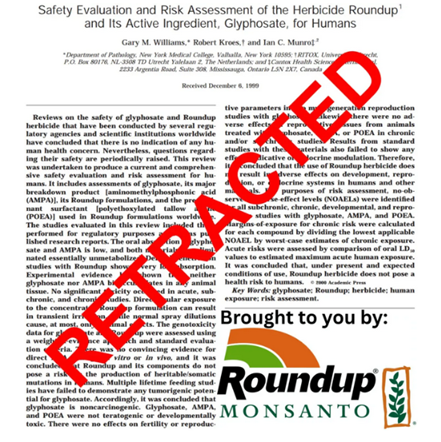
But it was all based on dishonesty. The 2000 “safety” review paper was written by Monsanto’s own in-house scientists. The doctor-authors listed were, to put it plainly, just signature proxies. Their role was to append their reputable names to research and pre-determined conclusions crafted entirely by the company’s employees. The same company that manufactured the poison.
Let’s be clear: this is the ghostwriting playbook. Monsanto’s scientists did the real work—they designed the narrative, analyzed the data, and wrote the manuscript to serve a corporate objective. Then, they handed this pre-packaged “science” to compliant doctors, who signed their names to it as if the words and ideas were their own intellectual property. The listed authors didn’t guide the research; they authenticated a forgery.
The mind-blowing part isn’t just the deception; it’s the brutal efficiency of corrupting the system. It turns the hallowed “author” credit—the very bedrock of scholarly responsibility—into a paid-for signature on a form, rendering the published literature a minefield of corporate ventriloquism.
For a quarter of a century, this study was a shield. It was cited in courtrooms and regulatory halls worldwide as a pillar of evidence for the herbicide’s safety. It was used to counter findings like those from the World Health Organization’s IARC, which classified glyphosate as a probable human carcinogen. Its retraction now is a seismic event, confirming what investigative journalists and persistent researchers have long alleged.
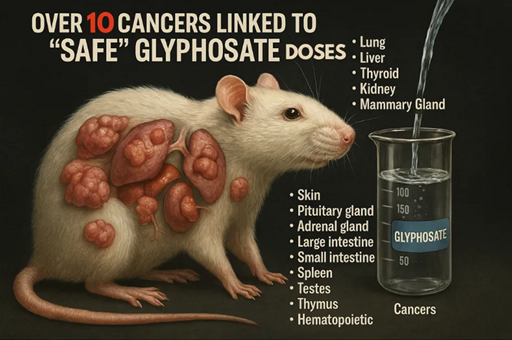
A recent controlled animal study just confirmed that glyphosate and Roundup can actually induce rare, aggressive, and fatal cancers across multiple organs—even at the very “safe” doses regulators have been happily rubber-stamping for years. Whoops! So much for that settled science.
Brace yourself, because Zhang et al’s 2019 meta-analysis basically took Monsanto’s “safe for humans” script and shredded it in a statistically significant woodchipper. What did they find? A glaring, undeniable link between glyphosate exposure and a 41% increased risk of non-Hodgkin lymphoma in humans. That’s not a fluke—that’s a five-alarm signal screaming from a data pool of over 65,000 people, including more than 7,000 documented NHL cases.
Let’s savor the irony: while industry-friendly “reviews” were busy playing defense, this research was quietly assembling a mountain of evidence that basically shouts: the higher your glyphosate exposure, the more your risk skyrockets. So, to anyone still clinging to those ghostwritten, corporate-sanctioned conclusions, maybe it’s time to explain how a 41% spike is just… background noise.
Some “safe” chemical, huh?
This retraction isn’t merely an academic footnote. It is a ghost that haunts tens of thousands of court documents and, more importantly, countless family homes. For years, plaintiffs from landscapers to homeowners have stood before juries, holding up bottles of Roundup and their cancer diagnoses. They spoke of non-Hodgkin lymphoma, of years of illness, of loss. And in defense, Monsanto, now Bayer, often pointed to the body of science—a body we now know included this fraudulent, ghostwritten organ.
The true weight of this news is not carried by the editors issuing the retraction. It is carried by the families who sat through trials, listening to complex arguments about science they were told was settled. It is carried by those who received a diagnosis and then, in their search for answers, were met with a towering, “scientifically-backed” wall of reassurance that may have been built, in part, on a lie.
The legal battles, as seen in verdicts across the nation, have already shown that juries, when presented with the internal company communications, believe deception occurred. They have awarded billions in damages, a staggering monetary reflection of the betrayal felt. This retraction is the institutional scientific community finally catching up to what those juries and those families already understood in their hearts.
So, what do we do with this moment?
First, we must remember the victims and acknowledge that a tool used to dismiss their suffering has been formally discredited. Their lived experience, so often batted away by “the science,” has been tragically validated.
Second, we must ask the urgent, systemic questions this exposes:
- How many other “independent” pillars of product safety are built on similar sand?
- What does true transparency in industry-funded research look like, and why is it so violently resisted?
- When will the systems designed to protect public health prioritize people over profit and paperwork?
Even though we’ve been talking about the dangers of Glyphosate for well over a decade, our role is not to say “we told you so,” but to insist that this must be a turning point. The pursuit of truth in public health cannot be a race against lawyers and ghostwriters. It must be a sacred commitment to the people whose lives, literally, depend on it.







Well written and very informative Ty, this should be a turning point, hopefully. I’ve spoken with my local State park reps casually here in southern Calif., who still use roundup, or a form of it), and they don’t really have much of an answer. I realize in large organizations, the decisions come down from the top, (in this case Sacramento), but the workers are especially put at risk, followed by us park users, not to mention the animals.
In my observation, many people today want things Easy, spray instead of pull, blow instead of sweep, (imagine how far things travel through the air), power tools, ebikes, (nothing against them) self-driving, right up to them saying, “tell me what to do”, (like getting jabs instead of doing their own research).
This is going to start a very welcome new round of litigation against Bayer (Monsanto), historical cases and new ones. Their silent war against the people of the world is collapsing. People have woken up to the endemic poisoning of the human race that only could end in big pharma (same owners) selling more drugs as people got sicker. “You are what you eat”. May the collapse continue.
This story should be front page news on every major newspaper in the country. Why haven’t the major television news outlets, covered this enormously important revelation? The answer is ‘human life has become a commodity for corporate consumption.’ We are nothing but tools used for wealth enhancement. When corporate entities destroy the watchtower for the citizens we call our federal agencies, using legalized bribery of lawmakers, they essentially become unaccountable to anyone. This unethical, unchecked corruption is deadly to law biding, patriotic Americans. When the mercantile interests of enormously powerful businessmen casually override the value of human life; the country is under the control of fascist elements. It’s time to end this fuckery.