
















There is a growing amount of research-based evidence that shows how crucial having a “healthy gut” (meaning a good balance of gut flora) is for your overall health and wellness − including your mental and emotional health.
Your gut contains a delicate system of over 100 trillion organisms – fungi, bacteria, yeasts, and other microbes – collectively known as your “microbiota.” Each organism has a purpose within the symbiotic community that is your microbiome.
More to the point, NOT having a well-functioning microbiome with the microbiota working in harmony can have some distinct health consequences.
Depleting the diversity of your microbiota, or letting specific strains gain the upper hand, creates an imbalance. This is also known as dysbiosis. Everyday things like sucralose, antibiotics, and your diet can adversely affect your gut flora balance. When this system is permitted to get out of balance, the synergy dissipates, and true chaos can occur… wreaking havoc on your body and mind.
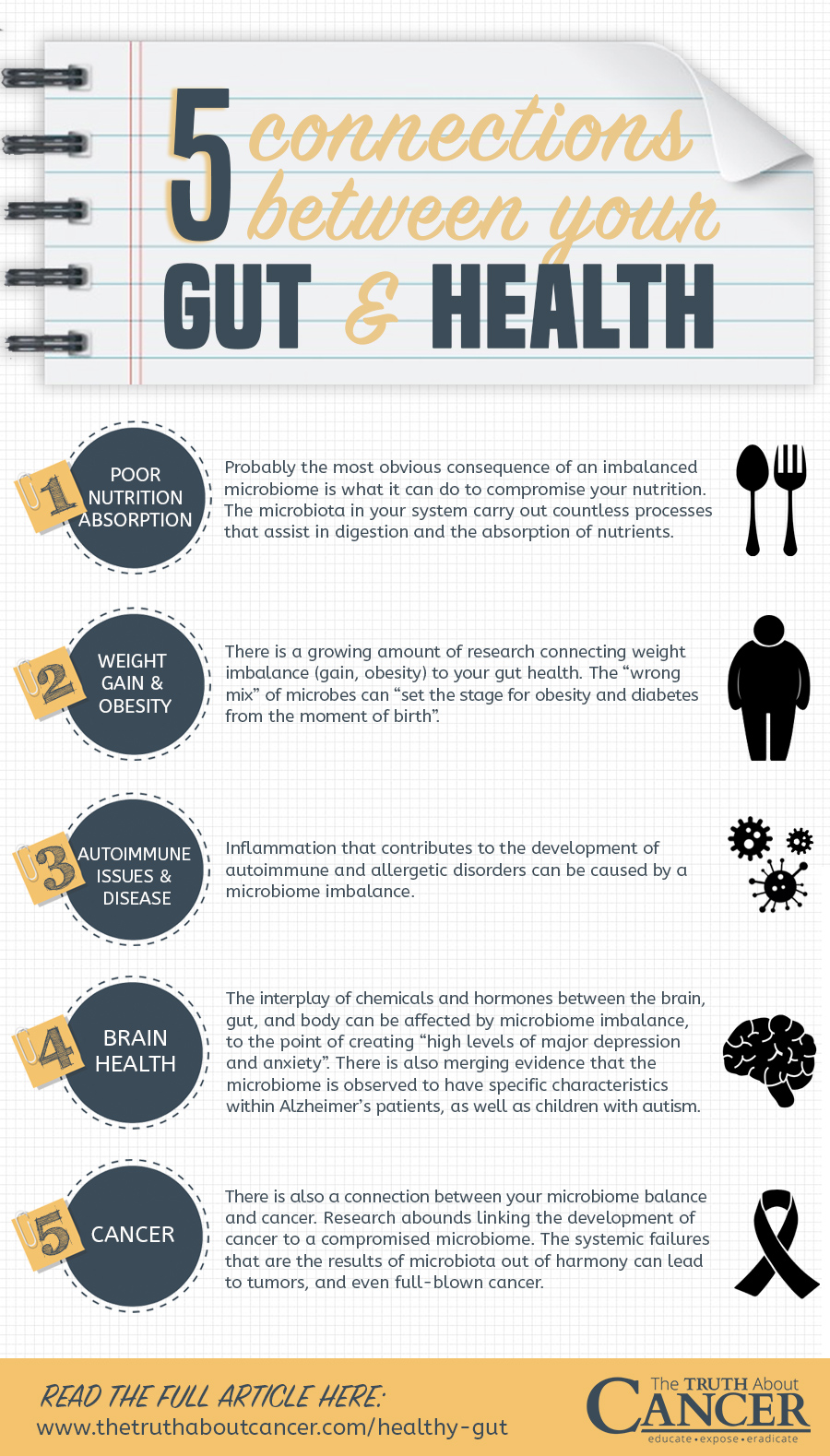
Here are just five specific areas of health and wellness that have been linked to gut health, or lack thereof:
Healthy Gut Impact #1 – Poor Nutrient Absorption
Probably the most obvious consequence of an imbalanced microbiome is how it can compromise your nutrition.
The microbiota in your system carry out countless processes that support digestion and nutrient absorption. As an article by Tufts University put it, “Your microbiota also work as vitamin-production plants. Bacteria in the gut synthesize vitamins, and those that they don’t use are excreted to benefit their host.”1
The body’s inability to properly absorb nutrients is known as malabsorption syndrome.
Mess with the balance of microbes, and the body will not get the full range of nutrients.2,3,4 You can be eating the healthiest foods on the planet, but if you can’t absorb them, there’s little benefit.
In addition, there are chemicals and vitamins created within your gut as a result of the many interactions between the different microbiota. Likewise, several amino acids and hormone processes are created by and connected to what happens in your microbiome.5,6,7 If your microbe family is in disharmony, these interactions may be altered, or not present at all, leading to deficiencies that affect your health, mood, and wellness.1,8,9
Healthy Gut Impact #2 – Weight Gain & Obesity
There is a growing amount of research connecting weight imbalance (gain, obesity) to your gut health.10,11,12
As stated in a Scientific American article, the “wrong mix” of microbes can “set the stage for obesity and diabetes from the moment of birth.” This is because the microbiome affects how your body stores fat, balances glucose, and responds to hunger-stimulating hormones, among other things.13
Experiments on mice suggest that we pass microbes back and forth between those close to us in our environment. The research seems to show that living with healthy people with healthy microbiomes can have benefits for those predisposed to weight problems, as long as they are living a healthy, probiotic-promoting lifestyle, as well.14
However, diet can also significantly alter the microbiome in just a single day! Mouse experiments showed that when mice ate a typical high-fat, high-carb Western diet, the healthy microbes didn’t “move in” to the obese mice, as they had previously observed. Diet still remains the biggest contributor to weight issues, even as it relates to a healthy microbiome and how your body processes fat, nutrients, hormones, etc.14
Bottom line (pun intended), seeking gut balance is a vital step for anyone with weight concerns.
Healthy Gut Impact #3 – Autoimmune Issues & Disease
The term “autoimmune disease” comprises over 80 health issues.15 What generally defines an autoimmune problem is that the body starts attacking itself – tissues, organs, cells, etc. – normally referred to as an “inappropriate response.”
This causes damage and inflammation, which creates further problems and can become a vicious cycle.
Ironically, it can often be inflammation that contributes to the development of autoimmune and allergic disorders, not least of which can be caused by a microbiome imbalance.16-19
Common autoimmune disorders include: lupus, rheumatoid arthritis, leaky gut, multiple sclerosis, and autoimmune thyroid disease.20,21
Healthy Gut Impact #4 – Brain Health (Depression & Chemical Imbalances)
You may be thinking: What? My gut affects my brain!? It sure does. To an even greater extent than previously known, according to scholars and scientists investigating the “gut-brain axis.”22,23
Here are a few facts to help you understand how your brain is directly influenced by your microbiome:
- There are more than a billion nerve endings in the gastrointestinal tract. Scientists have referred to this complex system of neurotransmitters, officially called the enteric nervous system, or ENS, as “the second brain.”
- Your ENS contains over 100 million neurons. This is more than both the spinal cord and peripheral nervous system, combined.
- Your ENS can function independently without the brain. The brain doesn’t overly influence the gut, but the second brain, your enteric nervous system, does influence the brain by sending signals and creating most of the body’s serotonin, around 50% of dopamine, and a host of other brain-influencing chemicals and hormones.16 This is called the gut-brain axis, or GBA.
- The effects of the gut-brain axis include emotional and cognitive functions.24
Also of note, there is emerging evidence that the microbiome is observed to have specific characteristics within Alzheimer’s patients, as well as children with autism. However, more research is required in both these areas.25,26,27
One area with more defined conclusions is the effect of GBA on mood.28,29
As mentioned in the bullets above, serotonin30 and dopamine are two brain chemicals produced in the gut.31-33 The interplay of chemicals and hormones between the brain, gut, and body can be affected by microbiome imbalance, to the point of creating “high levels of major depression and anxiety.”24
A 2014 study noted that depressed patients held certain strains of bacteria in common.33 In Sweden, researchers noted that mice bred microbe-free were naturally more daring and had less anxiety than mice that developed normal microbiota, or had various forms of it implanted.34
A healthy microbiome is so important to brain balance and psychological disorders that work is being investigated in “psychobiotics” – the use of probiotics to repair the microbiome, and thus reverse disorders.24,33,35
Healthy Gut Impact #5 – Cancer
I certainly can’t leave out the connection between your microbiome balance and cancer. Research abounds linking the development of cancer to a compromised microbiome. Essentially, the systemic failures that result when the microbiota is out of harmony can lead to tumors and cancer.36
A 2015 paper, Cancer and the gut microbiota: An unexpected link, revealed that epidemiological studies indicate damage to the microbiome as a major risk factor in cancer development. Once again, a GI system that is imbalanced leads to inflammation locally and systemically, which can so severely affect the body as to allow several different types of cancer to flourish.37
The improper balance of microbes in the body has been linked to colorectal cancer, breast and liver, among others.38
One thing is clear: anyone seeking optimal health, or looking to reverse existing problems, should view gut balance as profoundly important.
A quality probiotic diet, supplemented with substances that contribute to microbiota diversity and richness, is essential to your health and wellness.
What is a Probiotic Diet?
A probiotic diet includes quality probiotic foods and microbe promoters, such as fermented foods, foods rich in antioxidants and phenols, and lactic acid; plus prebiotic foods (which feed the probiotics). Avoid microbiome disruptors such as sucralose, antibiotics, alcohol, and preservatives.
We also recommend supplementing with a high-quality probiotic, preferably one with strong strains known to survive the digestive system, colonize well, and include other microbiota-enhancing substances.
Editor’s Note: This article was initially published in 2022 and has been updated in 2026.
Article Summary
Research shows how crucial a “healthy gut” is for your overall health and wellness − including your mental and emotional health.
Your gut contains a delicate system of over 100 trillion organisms that serve a purpose within your microbiome.
5 areas of health and wellness linked to gut health, or lack thereof:
- Poor nutrient absorption
- Weight gain & obesity
- Autoimmune issues & disease
- Brain health (depression & chemical imbalances)
- Cancer
A quality probiotic diet is essential to your health and wellness.








Hi team. Great article. I have minor Vitiligo since the last 6 months. It’s an auto-immune disease linked to a leaky gut. Do you have any information on the treatment of Vitiligo or know of any specialist that I can speak with. Thanks
Thank you for all that you do. I have been following you since your first book was published TTAC and I bought 3 copies. I tell my friends about you. Love u guys!
So, what are your thoughts on preventing or reversing Parkinson’s?
Dr. Thomas Lodi stated that parasites in your body might be the leading cause of diseases in people’s bodies such as cancer.
Ty y Charlene, valoro toda la información compartida, la aprecio mucho. Gracias gigantes por educarnos en estos temas que nos dan valor para enfrentar los asuntos delicados con la familia.
Sigan adelante, ¡ por la salud !
¡ Éxitos !