















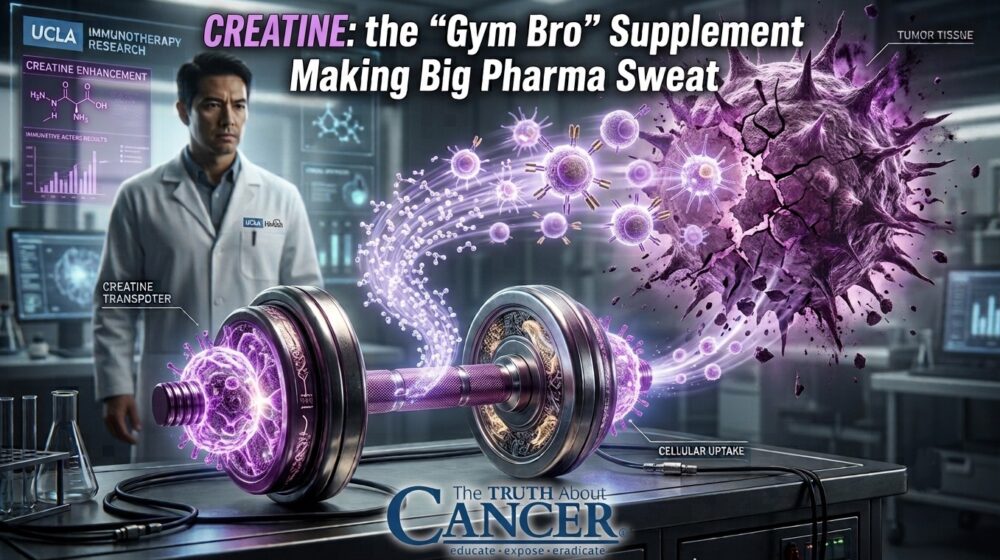
Let’s get one thing straight: if you’re waiting for your oncologist to recommend a $20 supplement over a $20,000 infusion, you’re going to be waiting a long time.
And what a plot twist it would be. Imagine the scene: a muscle-bound gym bro walks into a cancer ward, flexes his biceps, and says, “Hey doc, have you tried putting your patients on creatine?”
Ridiculous, right?
Except according to a new UCLA study published in the peer-reviewed journal iScience, the same powder that bodybuilders have been chugging for decades to get swole might just help your immune system bully cancer into submission.
And the best part? It costs pennies compared to the pharmaceutical alternatives.
💪 Creatine: Not Just for Bros Anymore
Here’s the deal. Creatine is a naturally occurring compound that helps your muscles regenerate ATP, the cellular energy currency, during high-intensity exercise. It’s been studied in over 1,000 clinical trials, has a safety profile that would make most drugs jealous, and has been used by athletes for decades to gain muscle and improve performance.
Now researchers at UCLA have discovered that it does something far more interesting than helping you squeeze out one more rep.
It supercharges your immune system’s cancer-fighting cells.
Specifically, creatine energizes dendritic cells—the “scout” cells of your immune system that detect tumors, grab fragments of them, and then alert the killer T-cells to come in and do the dirty work.
Think of it like this:
-
Killer T-cells = the soldiers on the front line
-
Dendritic cells = the intelligence officers who find the enemy and call in an airstrike
Without functional dendritic cells, your T cells are essentially fighting blind. And that’s exactly what happens in many cancer patients. The tumor microenvironment creates a nutrient-poor, energy-draining battlefield where these crucial immune cells run out of gas.
Enter creatine.
🔬 The Science: It’s a “Battery” for Immune Cells
The UCLA team, led by Professor Lili Yang, found something remarkable:
When they examined dendritic cells that had infiltrated tumors in mice, the gene responsible for the creatine transporter (the protein that pulls creatine into cells) was highly overexpressed. In other words, these cells were literally screaming for creatine.
When the researchers engineered dendritic cells that lacked this transporter, the results were devastating:
-
The cells survived less effectively
-
They were less active and less capable of priming T-cells
-
The T-cells they did manage to activate divided less and produced fewer signaling molecules needed to fight cancer
But here’s where it gets good.
When the team gave daily creatine injections to mice with melanoma, the tumors slowed their growth significantly. The treated mice had:
-
More dendritic cells infiltrating their tumors
-
More activated immune cells at the tumor site
-
Higher levels of inflammatory signaling molecules that recruit additional immune cells
The mechanism? ATP. Creatine acts like a “molecular battery,” helping dendritic cells maintain stable energy levels even when competing with fast-growing tumor cells for limited nutrients.
🧬 The “Hybrid Engine” Model
Here’s where it gets even more interesting. This isn’t the first time Yang’s lab has looked at creatine. Back in 2019, they published a study in the Journal of Experimental Medicine showing that creatine also directly energizes CD8+ T-cells themselves.
So creatine works on both ends of the immune response:
-
It helps dendritic cells detect tumors and sound the alarm
-
It helps T-cells have enough energy to actually kill the cancer
As Yang put it: “Creatine doesn’t just help the T cells fighting cancer—it also energizes the entire infrastructure” that supports and guides them. That makes creatine a promising supplement to holistically support the immune response that modern immunotherapies depend on.
The researchers have proposed a “hybrid engine” model where T-cells use glucose, amino acids, and lipids for fuel while also using the creatine system as a molecular battery to store energy and call upon it in the tumor microenvironment.
In a nutrient-poor tumor, where cancer cells are hoovering up all the glucose, having that backup battery can mean the difference between a T-cell that fights and a T-cell that gives up.
💊 The Immunotherapy Connection: 20-40% Response Rate?
Current immunotherapies (like PD-1/PD-L1 inhibitors) work by “releasing the brakes” on T-cells, but they only work for 20% to 40% of patients.
Why? Because even if you release the brakes, the T-cells might not have the energy to do their job in the nutrient-poor tumor microenvironment.
But when Yang’s team combined creatine with anti-PD-1 therapy in mice, they got synergistic effects. The combination was far more powerful than either treatment alone.
Most mice eradicated their tumors and developed a memory response that protected them against future tumor challenges.
That’s not just a cure. That’s immunity.
A systematic review published in Cureus in May 2026 examined all preclinical evidence and confirmed that creatine supplementation synergizes with PD-1 blockade by enhancing T-cell metabolic fitness and macrophage-driven inflammatory responses.
⚠️ The Catch (Because There’s Always a Catch)
Now, before you run out to GNC and start chugging creatine like it’s a cancer cure, let’s pump the brakes.
This is early-stage research. All experiments were conducted in mice and human cells in the lab—not in cancer patients. The UCLA researchers are the first to admit this.
“The researchers emphasize that while the findings are scientifically promising, this study was conducted in cells and mice, not patients” and no dietary or medical recommendations should be drawn from it.
There’s also a controversial 2022 study by Zhang et al. that suggested creatine might promote cancer metastasis in certain models. However, that study used:
-
Severely immunocompromised mice (lacking T-cells)
-
Extremely high creatine doses (5% of diet + 42.5 mg/mL in water)
-
Different tumor models
As the Cureus systematic review notes, studies that show creatine inhibits cancer use immunocompetent mice, while studies suggesting it promotes cancer use immunocompromised models. The immune system seems to be key.
🧐 What This Means for Big Pharma
Here’s where it gets spicy.
Creatine is a naturally occurring compound. It’s been around forever. It’s cheap. It’s off-patent. You can’t charge $10,000 a month for it.
And yet, the mechanism by which it works—energizing immune cells via a “molecular battery”—is being studied and patented by UCLA.
Sound familiar? It’s the same old story: nature provides a solution, and the medical establishment tries to find a way to own it.
From viper venom for blood pressure to Gila monster saliva for diabetes, Big Pharma has a long history of repackaging nature’s gifts at a 10,000% markup. Creatine’s potential role in cancer immunotherapy is no different.
A 2024 review noted that creatine’s role in cancer is “multifaceted”—it can inhibit or promote cancer depending on the context. But the immune-enhancing effects are consistent across multiple studies.
So what’s the play here?
Option 1: UCLA patents the use of creatine for immunotherapy and develops a proprietary formulation. You’ll pay $5,000 for their version of the same powder you can buy at Walmart for $30.
Option 2: The supplement industry latches onto this and starts marketing creatine as a cancer-fighting superfood. It gets studied more. It becomes a standard adjunct therapy alongside immunotherapy.
Option 3 (the most likely): It takes 10-15 years of clinical trials, gets FDA approval as a “drug,” and eventually a generic version becomes available long after it would have been useful to current patients.
🔬 What’s Next? A Human Clinical Trial
The good news: human trials are coming.
A Phase III randomized, double-blind, placebo-controlled trial is set to begin in August 2026, investigating whether 5g of creatine per day can prevent chemotherapy-related cognitive impairment in early-stage breast cancer patients.
Another grant-funded study from the National Cancer Institute is examining resistance training combined with creatine to promote physical function in sarcopenic colorectal cancer survivors.
And the UCLA team is actively seeking clinical collaborators to test whether creatine supplementation improves outcomes in patients receiving immunotherapy.
🏆 The Bottom Line
Creatine is a naturally occurring compound that:
-
Costs pennies per dose
-
Energizes both dendritic cells AND T-cells
-
Has been shown to eradicate tumors in mice with significant response rates
And yet, you can bet your oncologist has no idea this study exists. They’ll keep pushing the $20,000 infusions and the debilitating side effects. Because that’s the business they’re in.
The creatine is sitting on the shelf at your local supplement store. It’s calling.
The question is: will you listen before Big Pharma figures out how to patent it?💊
📚 References
-
Kang E, Elsten-Brown J, Wang YC, et al. Creatine uptake promotes dendritic cell activation and enhances antitumor immunity. iScience. 2026;29(4):115436.
-
Di Biase S, Ma X, Wang X, et al. Creatine uptake regulates CD8 T cell antitumor immunity. J Exp Med. 2019;216(12):2869-2882.
-
Li B, Yang L. Creatine in T Cell Antitumor Immunity and Cancer Immunotherapy. Nutrients. 2021;13(5):1633.
-
Shin J, Neupane R, Lopes G, et al. Creatine Supplementation in Preclinical Models Receiving Immune Checkpoint Inhibitor Therapy: A Systematic Review. Cureus. 2026;18(5):e108384.
-
Geng Y, DeLay SL, Chen X, et al. It Is Not Just About Storing Energy: The Multifaceted Role of Creatine Metabolism on Cancer Biology and Immunology. Int J Mol Sci. 2024;25(24):13273.
-
UCLA Health News Release. June 2026.
-
ScienceDaily Summary. July 2026.
-
NaturalNews Coverage. July 2026.
-
Creatine Conference 2025 Summary. June 2026.








Hmmm, it does say that they were injecting it into the mice. Vitamin C is pretty useless unless it is injected too, IVC. Maybe that is the key here?
How creatine works on mice, does not mean that it will do the same with humans since our immune systems are different from mice. Big Pharma would not use creatine as a cancer treatment since Big Pharma does not make a big profit. Even if they were going to use it as a cancer treatment, it will probably take many years.
Silvia, There is a great deal of research showing that the immune systems of mice and rats are, in important respects, highly similar to the human immune system. This is one of the main reasons why rodents are so widely used in immunological and medical research.