














What is CoQ10?
CoQ10 is also known as coenzyme Q10, Q10, vitamin Q10, ubiquinone, and ubidecarenone. The body naturally produces it. The “Q10” simply refers to the group of chemicals that make up the coenzyme.
The body’s cells use CoQ10 to produce the energy they need to grow and stay healthy. CoQ10 also has antioxidant properties that protect cells from harmful free radicals. Free radicals can damage a cell’s DNA, which is often linked to cancer. CoQ10 protects the body from the harmful effects of free radicals; hence, reducing one’s risk of developing cancer.
CoQ10 is found in all of the body’s tissues but is more concentrated in the heart, liver, kidneys, pancreas and lungs. CoQ10 is also found in: anchovies, broccoli, beef, salmon, sardines, mackerel, soy oil and peanuts.
As people get older, CoQ10 levels tend to decrease because of declining production or vitamin B6 deficiency. You can get vitamin B6 from chickpeas, avocado, roast beef, fish, chicken breast, tomato, and sunflower seeds.
CoQ10 was discovered in 1957, but researchers didn’t discover its benefits as an anti-cancer agent until 1961. Since then, numerous studies have examined CoQ10’s role in cancer.
How does CoQ10 work against cancer?
During its first discovery in the 1960s, it was ascertained that patients suffering from myeloma, lymphoma, and other types of cancer – such as head and neck, breast, lung, pancreas, colon, kidney, and prostate – had lower levels of CoQ10 in their blood. Studies suggest that CoQ10 can help boost the immune system. As a result, CoQ10 became one of several adjuvant therapies for cancer. An adjuvant therapy is an auxiliary treatment given after the primary treatment to augment the patient’s healing process.1 Since CoQ10 is a powerful antioxidant, it may be able to prevent the growth of cancer cells single-handedly.
Some animal and laboratory studies tested the effectiveness of CoQ10. Most of these laboratory studies aimed to identify CoQ10’s chemical structure and physiology in the body. Based on animal studies, CoQ10 dramatically improved the immune system, hence enabling the body to fight certain types of infection, as well as cancer. Another animal study revealed that CoQ10 effectively protects heart muscle from cell damage caused by the anticancer drug doxorubicin. Additional animal and laboratory studies determined that analogs of CoQ10 inhibited the growth of tumor cells. 2
Consequently, researchers investigated the effect of CoQ10 in human cancer patients. CoQ10 was tested as a protective agent in cancer patients taking the anticancer drug doxorubicin. Doxorubicin is an anthracycline drug which is said to induce cardiac toxicity by interfering with the energy-generating biochemical reactions of the heart muscle’s mitochondria. The mitochondria are considered to be the cell’s powerhouse, giving energy to the entire body system. Results showed that CoQ10 supplementation lessened cardiac toxicity.
Based on a study in Denmark, 32 women afflicted with breast cancer were given a nutritional supplement program consisting of vitamins, minerals, essential fatty acids, and CoQ10 along with their primary treatment. Results of the study showed that the participants used fewer painkillers in their treatment and they didn’t lose weight. It was also reported that there were six patients who showed signs of tumor regression, and all participants survived at least two years after their treatment. However, this study was poorly designed because it lacked a comparison group. Therefore, it is unclear whether tumor regression resulted from CoQ10. 3
Another study was performed in Canada to ascertain the effects of a combination of supplements, including CoQ10, among 90 women with breast cancer. The women in this study were given high doses of vitamins, minerals, and CoQ10 along with their standard treatment. When their outcomes were compared with those of 180 women who did not take high doses of combination supplements, there was no significant statistical evidence for the standalone effectiveness of CoQ10 as an anticancer agent. 3 Nevertheless, the above human studies did suggest that CoQ10 plays an important role against cancer when combined with other supplements.
Other conditions treated by CoQ10
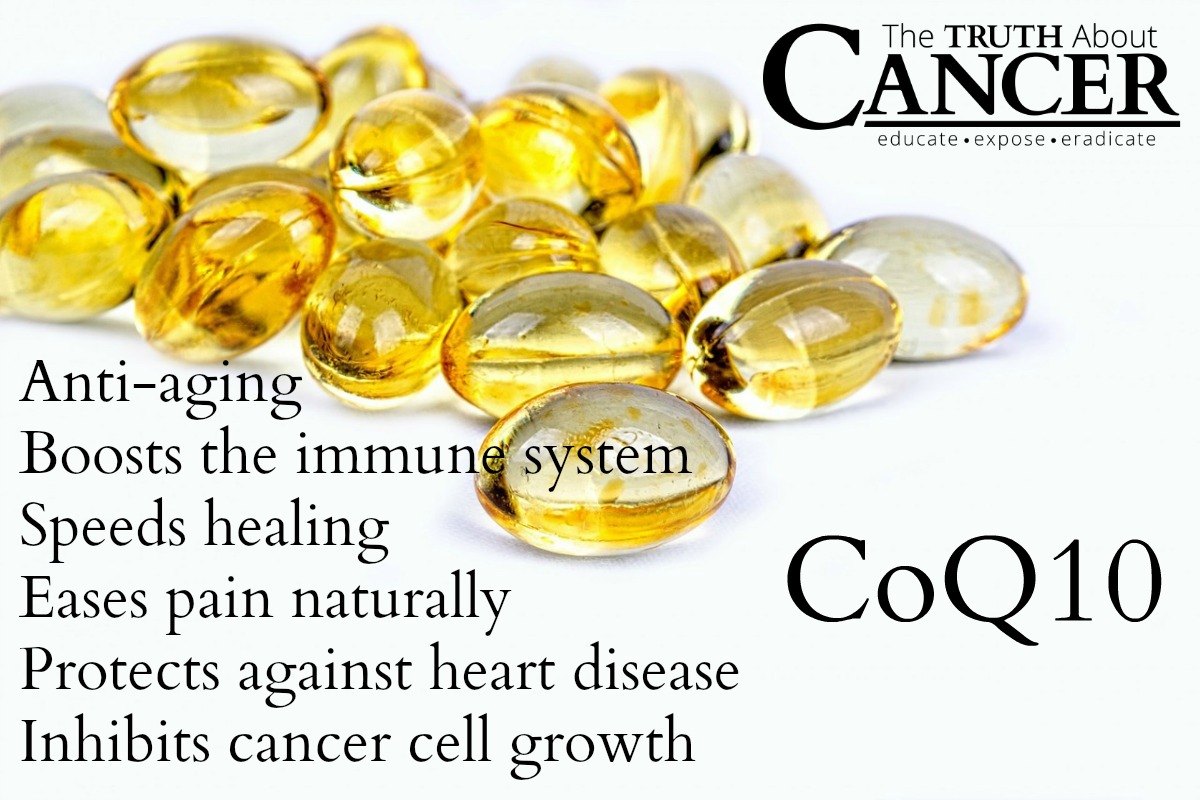
This powerful co-enzyme is not only good for fighting against cancer, but studies suggest that CoQ10, when given alone or combined with other therapies, can benefit your health in the following conditions:
Slows down the aging process. With CoQ10’s antioxidant power, it can help slow aging. When free radicals in the body are destroyed, cells stay healthy, with improved energy and vitality.
Prevents subsequent heart attacks. If you have had previous heart attacks, CoQ10 supplements might be the best preventive measure to guard against future heart attacks. Based on a clinical study, people who started a daily supplement of CoQ10 within three days after their heart attack were less likely to have subsequent heart attacks and chest pain. Researchers also found that those taking CoQ10 supplements were less likely to die of heart disease. 4 However, before you take CoQ10 supplements to prevent episodes of heart attacks, consult your physician.
Treats heart failure. Heart failure is a type of cardiovascular disease in which the heart fails to pump blood normally, causing blood to pool in various parts of the body, such as the lungs and legs. People with heart failure usually have low levels of CoQ10. Clinical studies show that CoQ10 supplements can reduce fluid buildup in your lungs and swelling in your legs. Once these areas improve, you can breathe easier, and your exercise capacity will increase. However, CoQ10 supplements should not be used to treat heart failure on their own. Ask your health care provider for possible treatment plans.
Lowers high blood pressure. CoQ10 can lower high blood pressure, but it may take 4 to 12 weeks to notice significant improvement. Based on an analytical review, CoQ10 can lower systolic blood pressure by up to 17 mmHg and diastolic blood pressure by up to 10 mmHg. 4 Although this looks promising, consult your health care provider when making important treatment decisions.
Improves blood sugar level. CoQ10 may benefit diabetic patients because it improves blood sugar levels, as well as heart health and blood pressure.
Aids in heart surgery. Studies suggest that CoQ10 may be given before heart surgery because it strengthens heart function and stabilizes the heartbeat. However, ask your health care provider before adding CoQ10 to your treatment plan.
Faster healing of gums. If you have gum problems such as swelling, redness, bleeding, and pain, CoQ10 supplements may help because they support gum tissue repair.
Other uses. Other studies suggest that CoQ10 may be successful in combating HIV/AIDS by boosting the immune system. People with HIV/AIDS are known to have weakened immune systems as a result of the AIDS virus. CoQ10 may also be used to treat migraines, Parkinson’s disease, and male infertility.
How to take CoQ10 supplements
A child under 18 years of age is not advised to take CoQ10 supplements unless prescribed by a health care provider. Adults 19 years of age and older are advised to take between 30 and 200 mg of CoQ10 daily. For better and faster absorption, take the soft gel forms instead of the capsule forms. Since CoQ10 is a fat-soluble supplement, take it with meals containing minimal fat.
When taking CoQ10 supplements, you may experience minor side effects such as fatigue, nausea, dizziness, insomnia, rashes, light sensitivity, irritability, headache, heartburn, and pain in the upper part of the abdomen. No serious side effects have been recorded with CoQ10 supplements, but to avoid possible complications, consult your health care provider. CoQ10 supplements may not work well with certain drugs that can weaken their effects. Also, CoQ10 might be contraindicated for persons taking blood thinner medications as well as pregnant women.
Editor’s Note: This article was initially published in 2024 and has been updated in 2026.







Ty, In 2006 I was flown by helicopter to Florida Hospital with a 100% blocked LAD – Yes, a full blown widow maker. A 15-20% EF and about 75% non-functioning heart muscle as estimated by my cardiologist, whom I first met in the hospital’s cath lab that Sunday evening. He recently told me that only about 5% of individuals with numbers like mine will ever return to their previous quality of life. One of the many recommendations from my cardiologist was CoQ10 (300mg/day). He is a strong believer in its effectiveness especially since my statin would deplete my body’s ability to produce CoQ10 . It quickly eliminated my earlier muscle pain (legs). I strongly suggest to anyone taking a statin, particularly if they experience muscular pain, to take CoQ10.
It is now 9 and a half years later and my quality of life has significantly improved. My EF (as determined by PET scan) is 41% at rest and 53% under stress with no angina. Today he estimated my current non-functioning heart muscle to be about 10% (it’s the first time I have ever asked him). Following are my current lab numbers: GLU=100; A1C=5.3; CHOL=124; LDL=59; HDL=46; CholRatio=2.7; TRIG=97; BP=115/68.
Do I attribute all my success to CoQ10? Of course not. However, I firmly believe that as part of a well regulated plan going forward the CoQ10 did significantly impact my well being. Did I mention I am 76, can easily walk 3 miles a day with an average speed of 3.2 mph with no discomfort of any kind. If heart patients are serious about making changes they should not procrastinate. This past summer I decided to not ingest more than 30gm of sugar a day. I have lost 25 lbs without making ANY other dietary changes.
I guess I should apologize for my evangelical rant but if it helps someone else it is worth it. I could write more details but I think I have made my point. Take control of your life. It’s the only one you get.
Thanks for a good article.
Nick
I have leukaemia CMLL/MDS with a white blood cell count of 40- should be between 4 – 10. Already taking COQ10 and lots of other supplements. Also using QRS magnetic mat. Late 70s in good health but worried as to what prognosis might be.
Were can I buy it?
Good quality [as in grass fed] egg yolks and heart and liver meat are rich sources of Q10 if you can find them and convince yourself to eat them. A few sources to check are EatWild.com and the your local Weston A Price chapter.
Natural Health 365
Has the TTAC ever heard of or published anything on the health benefits of lunasin? PubMed.gov has over 50 articles of study and clinical trials where lunasin has been proven to help fight cancer.
From what I’ve read it is the first “natural” food to have an epigenetic effect on the cells of the body.
Your thoughts!
Hi Dave,
I”m not sure that we have. Thanks for sharing this information with us!
I got her 2 + breast cancer in 2006, had Mastectomy and no other treatment.
In 2009 I had another Mastectomy in the same area+ 2 sessions of taxol and
1-year of herceptin infusion.
In 20014 the breast cancer metastasisid to my liver.
In 2017 it ended up in my Brain. I have had whole brain radiation & cyber surgery.
I came to this site to see if CoQ10 will hurt my Liver.
IF you take it in a whole food form as I mentioned above it should not hurt anything. I don’t know about a concentrated suplement form.
I already did on top.
thank you.
Gerson Institute at Gerson.org. Other resources are in Suzanne Somers book : Doctors Who Are Curing Cancer
What is best form of co q 10 to take – Ubiquinone or Ubiquinol. It is my understanding that in a well-functioning body, ubiquinone is converted to ubiquinol, which the active form of the anti-oxidant. For most folks over 40, it seems like it may be best to take COQ 10 in the ubiquinol form.
I agree based on my research. Just wondering why no mention of ubiquinol in this article.