














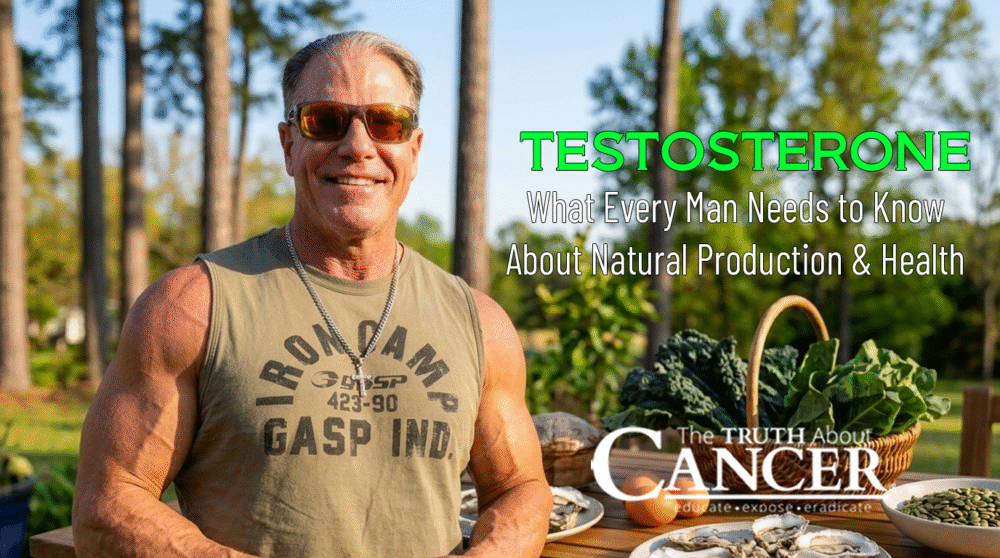
You may not know this about me, but I used to be a competitive bodybuilder, and I spent much of my time either in the gym, pumping iron, or in the kitchen, prepping food and eating. I had one goal in mind: to put on massive amounts of muscle to beat my competitors. And the single greatest factor that made that happen – the ultimate reward for lifting all that weight and consuming all that protein for months on end – was my body’s increased production of natural testosterone.
Testosterone is vital for building and maintaining muscle mass, which is why I worked so hard to optimize my body’s production of it throughout my bodybuilding career. But this vital sex hormone is necessary for so much more than just bulking up. Testosterone is a critical biological hormone that all men (and, to a lesser degree, women) need to stay healthy and vibrant.
To put it simply, testosterone is the essence of maleness. It’s the fundamental life force that makes a man a man, and the driving energy that keeps us guys fit, strong, and virile. Without it, we simply wouldn’t exist (at least not as men, anyway).
While our bodies are designed to produce testosterone and maintain it at optimal levels, there are many factors that can interfere with this natural testosterone production process. Exposure to toxins, poor diet, stress, and aging are among the most common.
These factors directly inhibit the body’s production of testosterone and other male hormones, collectively referred to as androgens. If left unchecked, this androgenic decline can lead to all sorts of health problems for men. This is why it’s so important to adopt healthy lifestyle habits that counteract the decline of natural testosterone and other hormones.
Where Does Natural Testosterone Come From, and What Does It Do for a Man’s Health?
Before I address how to do this, I’d like to explain a little more about how testosterone is manufactured inside the body and what it does besides create muscle tissue. Like with many other steroid hormones, testosterone production begins in the hypothalamus, a tiny region of the forebrain that stimulates many important processes throughout the body.1
In addition to regulating hormone production via the endocrine system, the hypothalamus governs many different homeostatic systems, including those that regulate sleep, emotions, and the central nervous system.
Whenever it detects that the body needs more testosterone to perform a given job, the hypothalamus ramps up production by secreting what’s known as gonadotropin-releasing hormone, or GnRH. This GnRH travels to the back of the brain, where it encounters the pituitary gland, which uses it to produce two additional hormones:
- Follicle-stimulating hormone (FSH)
- Luteinizing hormone (LH)
Both FSH and LH then make their way down to the testes via the bloodstream, where they are used to manufacture both sperm and free testosterone.2
One particularly interesting fact about testosterone is that the primary substance our bodies use to make testosterone is one that often gets a bad rap in mainstream medical circles: cholesterol. The primary building block of testosterone, cholesterol, is what the Leydig cells in a man’s testicles rely on (along with LH) to synthesize testosterone.
Once generated, this testosterone re-enters the bloodstream in free form, where the body is able to use it for many important tasks, including:
- Build strong bones
- Create lean muscle mass
- Strengthen the heart
- Generate new blood cells
Testosterone is also where manly characteristics like boldness, assertiveness, and competitiveness originate – not to mention the ever-present sexual drive that characterizes healthy manhood.
Common Symptoms of Low Testosterone in Men
In a perfect world, optimal natural testosterone production in men would happen all on its own. Every man would eat a healthy diet at all times, get adequate rest, drink plenty of clean water, exercise regularly, and never be stressed, be exposed to toxins, or grow older. In this ideal scenario, a man would never have to think twice about his hormones because they’d be virtually flawless. Unfortunately, the world is far from perfect. And the reality, truth be told, is that natural testosterone production is under massive assault on many fronts.
Low testosterone in men is more common today than it’s probably ever been. Many men’s bodies simply can’t keep up with their testosterone needs. Or when they can, too much of this testosterone ends up being converted to non-usable forms of testosterone, or worse: it’s converted to estrogen.
The result is that many men end up suffering from various degrees and symptoms of low testosterone.
Signs of low testosterone include:
- Lack of energy
- Moodiness and irritability
- Depression
- Brain “fog”
- Muscle atrophy
- Obesity3
- Loss of libido4
As disastrous as these health consequences are, if left unchecked, they can eventually give way to even worse symptoms that develop into serious chronic illness. We’re talking things that a typical “man’s man” absolutely dreads, such as:
- Cardiovascular events
- Dementia
- Infertility
- Gynecomastia (aka “man boobs”)
These and other advanced-stage symptoms of low natural testosterone are becoming all too common in our modern world, and yet viable options for men who suffer from these symptoms are few and far between.
What Are the Options to Boost Testosterone in Men?
Aside from testosterone replacement therapy (TRT), there really isn’t much else being offered conventionally to testosterone-deficient men that will actually help them recover. Now, TRT may be appropriate in certain cases. It typically involves low doses of synthetic testosterone compounds and is generally very safe. But TRT is often used as a band-aid, simply covering up the symptoms of low testosterone without ever getting to the root of the problem.
Then there’s the other issue. Symptoms of low testosterone—especially the ones affecting a man’s behavior and personality—are sometimes misjudged as simple character flaws. As in, just “man up” and face it. But here’s what most people don’t understand: Testosterone is the energy force that gives a man the confidence and wherewithal to face tough situations in the first place. Being deficient means a man isn’t necessarily capable of performing what society demands of him. He needs help. Not shame.
It’s a devastating situation on both sides, and it only reinforces a negative feedback loop for testosterone-deficient men, often making their symptoms worse. What men with low testosterone really need is solid guidance. Clear instructions on identifying where the problem lies and what they can actually do about it. And in most cases, that requires serious dietary and lifestyle changes—not just a prescription.
Getting Your Life Back: 4 Ways to Boost Natural Testosterone Levels
So what’s a man to do? If you’re seriously deficient in testosterone, TRT under the strict guidance of a properly trained physician may be a good starting point. Otherwise, it mostly boils down to these three things: diet, exercise, and sleep. If you can discipline yourself to address each of these things with clarity and resolve, you’ll already be well on your way to achieving more energy, less body fat, more muscle, and perhaps the biggest motivating factor: a robust sex drive.
I must stress that even if you don’t currently have low natural testosterone levels, it’s still critically important to eat right, stay active, and get plenty of rest in order to avoid developing it at some point down the road. Even if you don’t think you have low testosterone, it’s still a good idea to follow the steps below (and to have your levels checked just for good measure).
Natural Testosterone Booster #1: Eat more saturated fat, cholesterol, veggies, and nuts
Contrary to what you may have heard in the news or from your doctor, saturated fat and cholesterol aren’t your enemies. In fact, many foods rich in these two substances that popular culture has deemed as unhealthy – eggs, red meat, and butter, for instance – are some of the most nutritious androgen-friendly foods you can feed your body. (The caveat here is that these animal products need to be from pastured animals that are free from hormones, antibiotics, and that themselves are consuming a quality diet.)
Studies suggest that avoiding saturated fat and cholesterol can actually damage testosterone production and lead to deficiency. Vegetarians are likely candidates for this, as the standard vegetarian diet typically lacks both of these vital dietary elements.5 This doesn’t mean you should avoid vegetarian (plant) #foods. Nuts, cruciferous vegetables, and leafy greens are all extremely beneficial for boosting testosterone levels.
Natural Testosterone Booster #2: Combine plenty of clean protein with resistance exercise
I still lift weights about six days a week, and I realize that if testosterone is the engine that gets muscle production going, protein is the fuel. The two definitely go hand in hand when it comes to building anabolic strength, and studies suggest that consuming clean protein that provides the full spectrum of essential amino acids (I prefer organic egg white protein) may help boost testosterone levels when combined with resistance exercise.6
Science shows that testosterone levels in men tend to reach their peak about 30 minutes after they exercise. A solid training approach that can help to maximize these peak levels includes working large muscle groups using compound movements rather than isolation exercises. For example, lifting heavy weights (5-6 sets with 6-8 reps) and resting for no more than about 1 minute between sets.7
Natural Testosterone Booster #3: Get at least 5 hours of restful sleep per night
A lot of guys overlook the importance of sleep. “I’ll sleep when I’m dead,” many of them would say. But letting your body rest is critical both for muscle building and testosterone production. Not only does restful sleep help your body to manage and overcome stress, including by minimizing stress hormones like cortisol that wreak havoc on testosterone, but it also helps your body to produce more testosterone. Researchers from the University of Chicago found that young men who get less than 5 hours of restful sleep per night have up to 15% lower testosterone levels than their well-rested counterparts.8
Natural Testosterone Booster#4: Avoid xenoestrogens and take natural vitamins and supplements
Endocrine-disrupting chemicals are everywhere these days—plastics, pesticides, and personal care products are loaded with them. That’s why I suggest avoiding them and sticking with natural alternatives.
But avoidance alone isn’t enough. You also need to actively support your body. Supplementing with testosterone-supportive trace minerals such as zinc and selenium, along with B vitamins and herbs like tribulus terrestris and stinging nettle, can help counteract the effects of environmental toxins and give your body that little extra androgen boost.9
One natural testosterone booster I take every day is “Miso Horny” (from our friends at Miso Healthy), which contains Horny Goat Weed and Organic KSM-66® Ashwagandha for hormone balance and vitality, plus clinically studied Mango Bark Extract, Indian Globe Thistle, Ginseng, Tongkat Ali, Shilajit, and Organic Zinc to promote strength, endurance, and performance across mind and body. No fillers. No synthetic junk. Just science-backed ingredients that actually help your body produce what it needs.
Editor’s Note: This article was initially published in 2017 and has been updated in 2026.
Article Summary
Testosterone is the fundamental life force that makes a man a man, and the driving energy that keeps men fit, strong, and virile.
While our bodies are designed to produce testosterone and maintain it at optimal levels, there are many factors that can interfere with this natural testosterone production process.
The primary substance our bodies use to make testosterone is one that often gets a bad rap in mainstream medical circles: cholesterol.
Many men end up suffering from various degrees and symptoms of low testosterone.
Signs of low testosterone include:
- Lack of energy
- Moodiness and irritability
- Depression
- Brain “fog”
- Muscle atrophy
- Obesity
- Loss of libido
As disastrous as these health consequences are, if left unchecked they can eventually give way to even worse symptoms that develop into serious chronic illness.
Even if you don’t think you have low testosterone, it’s still a good idea to follow the steps below:
- Eat more saturated fat, cholesterol, veggies, and nuts
- Combine plenty of clean protein with resistance exercise
- Get at least 5 hours of restful sleep per night
- Avoid xenoestrogens and take natural vitamins and supplements







Thank you for this article, Ty. I´d say that I already knew the information you share in your article. However, I have never seen before the whole picture summarized as you have put it here, so simple and natural that made me wonder how couldn´t I see this before. Your article helped me to connect the dots, and this will have a massive influence in me.
Understanding throughoutfully is the first step for me, to make a decision and then a shift. So this great article came just in time… Thanks again!
We are so glad that the article was informative and helped you understand these topics better!
I think you pretty much covered all the major points. Tons of information here for those needing it like myself!
hey awesome post
Awesome information Ty. I just turned 89 in November and have been athletic all my life and still going to the gym and exercising. I’ve had a few bumps along the way (hip replaced, a prostatectomy, might have a torn rotator cuff…) but still ticking.
will add these suppliments to my list.
Really informative and superb body structure of content, now that’s user friendly (:.
Great feedback! Thank you so much for sharing your thoughts with us. 🙂
Blessings and love!
My husband does all of the recommended things but still seems to have low testosterone. Recently heard from a well educated alternative Dr. that human identical hormones instead of bioidentical or HRT type is the answer to replacement. But where to find these?
I go for walks every day in the park for 90 minutes or two hours and I dance for a few hours in my bedroom every day.
Love it
Exactly what I Am doing
Having fought cancer twice and toxic poisonous chemo 2013,2014,radiation 2014.
Then again cancer 2017 and poisonous chemo
Until Oct.2017 when I walked away from chemo without consulting with the demon oncologist and decided to go natural.
God is Blessing me
Sepsis septic shock twice and to top it off a heart attack June 2018.
This is what my body needs to remain strong
In all ways
Thank You
God Bless You and your family
🙏❤🕊😃
Joe