















Enzymes play a vital role in human health and well-being. They are imperative for optimal digestion, nutrient absorption, immune response, cognitive thinking, and systemic cellular detoxification, among many other life-essential processes. Since the early 1900s enzyme therapy has been used as a natural protocol to heal cancer and has showed tremendous promise.
Enzymes are protein structures which take on different shapes and are designated for different purposes, such as one might compare a lock and key model. Enzymes are some of the most important structures in your body. They help heal and support good immune response to help prevent disease and cancer.
Enzymes have catalytic responsibilities. This means they help speed up the rate of chemical reactions in the body and better enable biological processes to occur. It is estimated that we have over 7,000 reactions in our bodies which take place with the assistance of 3,000 specific enzymes.
Your digestive tract relies on many different types of proteolytic enzymes to help break down your food. Proteolytic enzymes are a type of digestive enzyme that break down protein into amino acids. When taken on an empty stomach, proteolytic enzymes pass into the bloodstream and become Systemic enzymes. Systemic enzymes are enzymes that work outside of the digestive system and participate in the reactions within your body’s cells.
The Role of Systemic Proteolytic Enzymes on Cancer
A thick outer coating called fibrin covers cancer cells. This coating is used to shield cancer cells from the immune system. Not only does the fibrin keep the immune system from identifying and destroying the cancer cells, it prevents chemotherapy from doing the same thing unless the chemo is used at industrial strength doses.
The use of systemic proteolytic enzymes allows lower doses of chemotherapy to be utilized. It also helps to reduce the side effects of chemotherapy and to limit the waste buildup produced during treatment.
Some of the side effects of chemotherapy include vomiting, diarrhea, fatigue, pain and nausea. Enzyme therapy has shown promising results in limiting these symptoms by reducing the cytotoxic (poisonous) effects that chemotherapy has on the body.
Radiation Therapy, Surgery, and Enzymes
Radiation therapy for cancer causes organ damage and rigid scar tissue in the affected organ. This scarring limits the function of the organ. Proteolytic enzymes, however, can prevent the buildup of scarring and stimulates organ function by diminishing pre-existing fibrosis (formation of excess tissue). Proteolytic enzymes also assist individuals undergoing surgical procedures by speeding up recovering time.

Systemic Proteolytic Enzymes and the Immune System
Research shows that enzyme therapy decreases inflammation, stimulates cytokine production, and increases the defensive powers of natural killer cells and macrophages. Both natural killer cells and macrophages scan the body seeking abnormal cancer cells and viruses. Stimulating these immune system defenses reduces the risk of cancer developing, growing and spreading.
Systemic enzymes regulate the activity of the numerous responses of the immune system. They are attracted towards pro-inflammatory cytokines including tumor necrosis factor (TNF) and C- reactive protein(CRP). Enzyme therapy can be used to decrease the over stimulated activity of tumor growth factor-beta at the site of protein synthesis. There have been no major adverse side effects from the use of systemic enzyme supplementation.
Enzymes Have Anti-Proteinase Activity
Anti-proteinases, including α-1-antitrypsin and α-2-macroglobulin, are found to bind irreversibly to systemic enzymes. When this occurrence happens, other anti-proteinases are stimulated and shut off the function of tumor regulating proteinases such as cathepsin. As a result, cancer metastasis is inhibited.
In fact, the field of oncology is increasingly using the ratio of proteinases to anti-proteinases to make a cancer prognosis. Papain and bromelain are cysteine groups found in proteinase components and can influence tumor development.
Adhesion factors which play a critical role in tumor growth and metastasis are CD-44, CD-49, CD-54, and CD-58. Enzymes interact with these adhesion factors. They also promote antioxidant enzymes which in turn reduces free radicals. Reactive oxygen species is a potent free radical which causes havoc on the body and also by initiating oncogene expression.
Systemic Enzyme Use
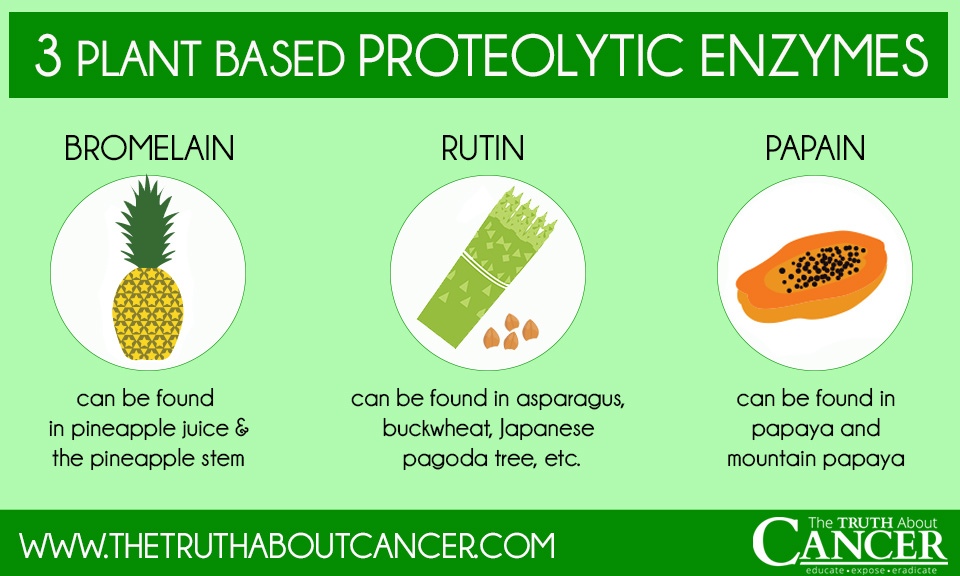
Systemic enzyme supplementation is best coming from an array of plant and animal enzymes. When you consume raw, sprouted, and fermented vegetables and fruits you are taking in more enzymes. Three of the best plant-based proteolytic enzymes include papain, bromelain and rutin. Chymotrypsin, pancreatin, and trypsin are enzymes from animals.
Systemic enzymes are formulated to reach the bloodstream fully intact and not become dissolved in stomach acid. To ensure optimal absorption, systemic proteolytic enzymes should be consumed on an empty stomach. This allows for their passage into the bloodstream where they can then be circulated throughout the entire body. Specific protease enzymes which break down protein have been found to have a powerful impact on fighting inflammatory and fibrinolytic activity (blood clot formation).
High Dose Enzyme Therapy and Intermittent Fasting
When systemic enzymes are used in conjunction with intermittent fasting, a synergy of benefits exists. Practicing intermittent fasting for periods of 16 to 18 hours can improve immune system support, increase human growth hormone, and better equip the body with a better source of fuel for the brain and body in the form of ketones. Intermittent fasting has also been shown to improve hormone signaling as well as to stabilize blood sugar, and increase fatty acid metabolism.
High dose enzyme therapy is best recommended for individuals who use intermittent fasting to heal. In order to be most effective, systemic enzyme therapy must take place outside a period of food consumption.
The best time for enzyme supplementation is during the morning when most people can fast on cleansing herbal beverages and lemon water. Furthermore, it is also recommended to go to sleep on a stomach that is not trying to digest and absorb nutrients from a meal too recently consumed before bedtime. If you are not a morning faster, high dose enzyme therapy may be more appropriate for you before bedtime.
Dosing Recommendations for Enzyme Therapy
Cancer Prevention: 5 to 20 grams daily. Preferably 10 capsules in the morning and 10 capsules before bed.
Cancer Patients: 20 to 80 grams proteolytic enzymes daily. Dosage split into 30 capsules in the morning, 20 capsules 3 hours later (preferably 2 hours before and after eating), and 30 capsules before bed.
Metastatic Cancer Patients: 45 to 160 grams daily split into 40 capsules in the morning, 40 capsules later, and 80 capsules before bed.
Article Summary
Since the early 1900s enzyme therapy has been used as a natural protocol to heal cancer. Enzymes are essential for optimal digestion, nutrient absorption, stimulating immune response, cognitive thinking, cellular detoxification, and other processes.
Proteolytic enzymes are a type of digestive enzyme that break down protein into amino acids. Systemic enzymes are enzymes that work outside of the digestive system and participate in the reactions within your body’s cells. When proteolytic enzymes are consumed on an empty stomach, they pass through into the blood and become systemic enzymes.
The use of systemic enzymes allows lower doses of chemotherapy to be used. It also helps to reduce the side effects of chemotherapy and to limit the waste buildup produced during treatment. System proteolytic enzymes assist people undergoing surgical procedures by speeding up recovering time and reducing scar tissue.
Enzyme supplementation is best coming from an array of plant and animal sources. Three of the best plant-based proteolytic enzymes include: papain (from papaya), bromelain (from pineapple), and rutin (from asparagus & buckwheat).
Systemic enzymes are formulated to reach the bloodstream fully intact and not become dissolved in stomach acid. There is a synergistic effect when using systemic enzymes in conjunction with intermittent fasting.
Dosing Recommendations for Enzyme Therapy:
- Cancer Prevention: 5 to 20 grams daily. Preferably 10 capsules in the morning and 10 capsules before bed.
- Cancer Patients: 20 to 80 grams proteolytic enzymes daily. Dosage split into 30 capsules in the morning, 20 capsules 3 hours later (preferably 2 hours before and after eating), and 30 capsules before bed.
- Metastatic Cancer Patients: 45 to 160 grams daily split into 40 capsules in the morning, 40 capsules later, and 80 capsules before bed.








Thanks for these infos I was going to ask you where can we find thoses enzymes .,so I have heard that spargus also Could give you kidney stones…just a saying that I heard years ago I don’t know if it is’true..they at that time talked about acid uric..so if you know anything about that would appreciate..and beside those three fruits and vege would you know of others vege and fruits that would contain also those enzymes?..cause people not living in southern reas for pinepples ..and other would appreciate very much to know…..do you think that canned pineapple would be as good as the fresh ones?..I doubt because of the heat they go throu to be put in a can thou…thank you very very much…
Ok Great article but where is the link to the supplement you’re talking about?
There are several great systemic enzyme products on the market. The one I use is Wobenzyme here: http://store.drjockers.com/products/wobenzym
This product: https://store.drjockers.com/products/proteozyme
Capucine, I would DEFINITELY not recommend canned pineapple. I would recommend finding a proteolytic enzyme supplement and taking the standard dosage each day to get these benefits.
Yes thanks doc about your advice in reality I just asked this question.if one day we were out of everything as a world wide catastrophy let say…
Well just pointed out that I just finished hearing Charlotte Gerson …I will give you the link here…https://www.youtube.com/watch?v=aYYlX8aRj3E
Even thou I know almost everything she said makes me happy to hear it again and…little details which aren’t really…like drinking very very fresh juices ..not juices even from the morning kept in fridg…right on the spot…enzymes dies after a short time…
…and other things..
She spoke about genetics also..saying that yes it can stop cancer ..but doesn’t stay stopped fter. While it comes back…..certainly ..it is my guess…that we don’t keep up eting to keep the alcalinity of the body way up.. …
This video is very interesting she is 91yers old..and if you can once you see it..tkes an hour..yes a little long but worth it….so if you jve time tell me what you think ..i believe as what she said several times….that all is mingled…all is interconnected….and of course who can deny this..also we hve to know what to do to begin by detoxifying…to do it wisely…how to begin intelligently,,to keep going..silently but surely..while we can..nd get things in our body better little by little..thanks for reading…
I am too old now but really all this is sooo interesting..it is a link to spirituality ..when the body is in shape..we can go a long long way in all directions…….
My mum is taking 3000 gdu per day bromelian for her metastatic cancer, how does that compare to the dosage you suggests for cancer? How many gdu per day is it safe for her to take?
My mother has metastatic cancer as well. Started as breast cancer and spread to her bones now her brain. She takes chemo every 3 weeks to basically keep her alive. The chemo is just know damaging her heart. How much would she need of this to help her. Can the same amount be found in fresh fruit? Of course were desperate to keep this cancer from killing her. Please help me.
Hi I use wobenzyme as well but at the dose on the bottle, how long do you recommend using the cancer treatment and metastatic dose for? A day? A week? For ever? The wobenzym is pretty expensive do you know of a liquid form?
Are you serious? 80 capsules a day (systematic enzymes) for metastic cancer?
That means nearly an entire bottle every day & at $30 a bottle, most of us can’t afford that!
I take over 50 different capsules a day now & find it very challenging at that!
masszymes by Bioptimizers is the brand I use.
Most proteins breakdown in the stomach through proteolytic action of stomach enzymes. Can you give a reference of research showing evidence that bromelain and papain are absorbed into the blood stream if consumed on an empty stomach?
I’d like to know the same. I think they need to be taken with food for optimal digestion. Your systemic enzymes however should be on an empty stomach.
thank you for this important information……I need this infor. but didnt get it from any of my cancer doctors nor the nutritionist……I hope to read more about these ideas to prevent cancer……renee ^.^
How would you use the fruits, rather than the tablets?
Can you purchase in Canada?
Yes I am sure you can get these in health food stores in Canada. Wobenzyme is a popular product
sounds good but I would rather take the fruits than pills…..foods have everything we need…its just that many of us dont know how to choose whats better for us…….I am learning all the time ……^.^
Yes everyone, it is expensive and not at all convenient because you have to take A LOT of pills outside of meals (at least an hour and preferably 2+ hours) to get the astonishing results described in the article. This is a therapy that Nickolas Gonzalez has used and has hundreds of documented cancer healing testimonials. His top 3 therapies were strict diets, very high dose enzyme therapy and coffee enemas. Not the most fun but this saved lives and still does today!
As a clinician, I have had trouble getting people to be compliant due to the cost and amount of pills people need to swallow. Most people think that natural methods only involve a diet and lifestyle change, and that is the foundation, but just like the conventional method, which uses expensive and uncomfortable treatments such as chemo and radiation….natural strategies can often be expensive and uncomfortable (although significantly less cost than conventional and not nearly as uncomfortable).
Ultimately, you choose the route you want to take. Eating the fruits may be good, but you won’t get the amount of enzymes you need to get the kind of results described in the article. Hope that helps clear up some confusion. I take 10 caps – 2x daily myself and LOVE IT! Less pain, better skin, better exercise recovery, improved immunity and energy are the side effects!
Expensive? By far most people can not afford to do that therapy. even the recommended preventive dose is way out of reach for most. don’t even know why they even put this info out there
Cancer treatments cost people their houses and life savings not to mention sometimes their lives. I have hear good things about the enzyme treatments. I wonder…..if it possible to empty the capsules and drink them ?
So how long after taking systemic enzymes (on an empty stomach in the morning ) do I wait to eat ? One hour preferably 2 you say ?
You take 10 caps – 2x daily of Wobenzyme? The reason I don’t take Wobenzyme is because they come in tablets, not capsules. Any other enzyme product you would recommend, preferably in a capsule form?
is Inf-zyme the same basic product as Wobenzyme?
I have read that fresh or frozen pineapple has the enzymes. There is a loss of enzymes when pineapple is canned due to processing.
I take pHi-Zymes systemic, proteolytic enzymes from Baseline Nutritionals. Order online. I take for arthritis, but good to know my intermittent fasting and taking Phi-zymes will help prevent cancer.
Dr Jockers, what do you think of phi-zymes by baseline nutritionals? Any opinion? I’m giving them to my mother as part of her protocol for breast cancer, but only 15 caps per day. Do you think it can have any effect at all at that dose? We are of course combining with other things, dmso/iodine topical, all essential vitamins, minerals, digestive enzymes, probiotics, frankincense orally/topically, low carb no junk diet, no sugar, fermented foods, organic foods when possible, green drinks, and daily vegetable juicing.
Dr. Jockers — I have an unresectable benign (precancerous) colon polyp and am attempting to avoid prophylactic colectomy, which was advised. I’m using mainly the Gerson protocol, but also am combining that with systemic enzymes (per Dr Nick Gonzalez and the protocol you described above). However, after three weeks of this protocol I have noticed increased pain in the area of the polyp. I have heard that this means the enzymes are working, but I am concerned the opposite may be true. A study published in the World Journal of Gastroenterology in 2014 (link pasted below) found that “Proteinases may have a crucial role not only in the invasive process of CRC, but also in the progression of precancerous conditions and lesions to CRC.” I’m not sure if this refers to the proteinases lreasy present in cancer tumors, or those present in supplements. What is your interpretation of these findings? I would appreciate any information that could help me make a decision for how to proceed. — AS
Andrea,you mentioned you follow Nick Gonzalez advise/protocol of using systemic enzyme.what is your progress now,what brand do you use (Nutricology ?) ,if Nutricology,what kind of them lamb,pork or beef? Thanks! Also,I’m interested pancreatic enzymes versus plant based,which of them have better result in immune deficient cancer (leukemia,melanoma…)
I use Nutrissa Digestive Enzymes 4x purchased from Amazon.
Thanks for the answer! How many pills per day and how long do you take them? Do you make any breaks between ?
Hello dr. Jockers
I think it’s a great therapy, enzyme therapy.
It is cheap we can combine dietary supplements and functional foods
It is very important to keep in mind, that most people from 40 years of age, begin to have a deficit of enzymes and hydrochloric acid.
A daily supplement can be a good prevention
i am not wanting to juge or else to the ones that wants to get rid of their cancer by using animal products….but would like to have a colloque with different kind of cancer survivors ..with the same cancer and their different ways of healing…understand what came out of their experience ….
Are those enzyms coming from animal?…if so i deplore that we have to count on the death of animals to get healed of cancer.
..i am vegetarien and of course and i think like this because I can’t realize in my mind that i have to kill an animal to get rid of a cancer…taking a life to save mine ..that is a thing not very logic….there are other ways …just try to imagine how an animal you would kill to heal yourself..
The death of an animal means fear, hatered…in his body .AND….you are going to eat his …fluids full of fear…which are full of toxins..if you want to see it like that instead of seeing it with your heart….just imagine it with your intelligence then…
Aren’t they any other way to get rid of the cancer besides this one?….so many people have stopped all meat or else coming from animals and did cure their cancer…..
Aren’t they any other way to consider cancer as a thing to try to understand….we all know it is a message of the body…talking to the person hersef..as a person to another person…., so many people have said that due to their cancer they learned so many things during their cure..learned things on themselves..and changed so many things in their lives…..
I have been taking Pancreas 3 times a day 18 pills. Per dosage. I have a ton of pain in my legs from an old injury and have tried everything to fix them. I have noticed headaches and frequent urination but not any difference in pain. It has been 3 weeks. What should I be looking for ? I don’t know if this is working or not.
I always take on an empty stomach.
Hi Kurt –
We appreciate you reaching out to us about this.
I’m so sorry to hear about your friend – I’ll be sure to pray for her.
Unfortunately, we are unable to give any kind of medical advice. The best advice we can give you is to consult with one of the doctors we interviewed in the Global series.
Please note that we are not able to select an expert for you.
We’ve created a page with the experts’ contact info as it was available to us.
Here’s the link to the actual webpage:
http://thetruthaboutcancer.com/experts-info-sheet/
We do have one more resource you may be interested in. During our Live Event 2017 series, Dr. Patrick Quillin suggested contacting The Institute of Functional Medicine to locate a practitioner in your area.
If you are interested, here is the link to search for a Functional Medicine Practitioner in your area: https://www.ifm.org/find-a-practitioner/
Please do reach out to these doctors to learn about how you can correct this.
Wishing you endless blessings and love!
The results of a research study concluded that PSA, an enzyme, causes prostate cancer cells to spread. Here’s a quote from a summary:
“The researchers discovered two new proteolytic enzymes (proteases) which are able to activate both growth factors, VEGF-C and VEGF-D. One of the enzymes is the prostate-specific antigen (PSA), which is also used as a marker for prostate cancer.”
I used to take Wobenzym but based on this study I am going to stop. As far as I can tell from searching, the evidence for the effectiveness of proteolytic enzymes against cancer seems to be all anecdotal.
What proteolytic enzyme do you recommend for maintaining resistance to the spread of ovarian cancer. My wife is in remission at the time, but CA-125 score is threatening recurrence